|
|
The British Aircraft Corporation was formed by a Government forced merger of Vickers, Bristol, English Electric and Hunting. The 'One-Eleven' was the first commercial aircraft produced by the newly formed BAC. It was designed as a jet replacement for the earlier turboprop Viscount which had been extremely successful. This gave the 1-11 a clear place in the aviation market and unlike the VC10 and Trident it was not hindered by the strict specifications of a single airline. Early trials gave problems, with the prototype crashing a few weeks into testing. An unrecoverable deep stall was found to be the cause, the 'T' tail being caught up in the air disturbance from the main wing.
| |
 |
| |
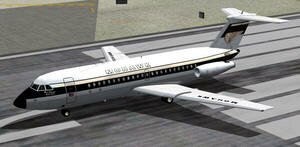
| One of the 1-11 launch customers, Mohawk, in its attractive original black and gold livery. The fleet later passed to Allegheny. |
|
The main wing leading edge was redesigned, along with the elevator controls. The original elevator, a non-powered servo-tab design, was replaced with a more reliable hydraulically assisted elevator with geared tabs to ease the loading.
Despite the early problems, an impressive 60 plus orders were secured prior to its production, including important orders by the US airlines Braniff and Mohawk.
The 200 series entered service with British United Airways in April 1965 and later the same year with Braniff, Mohawk and Aer Lingus. It was powered by the new Rolls Royce Spey 506 turbofans and carried up to 79 passengers on short haul routes.
 |
|
| The big order from American was a major coup for BAC. However the aircraft were fairly quickly replaced as US made alternatives became available. |
|
|
The upgraded 300 and 400 series had the more powerful Spey 511 engines. It had increased operating weights and could carry up to 89 passengers.
There were a number of minor design changes with the main visual difference being to the nose wheel undercarriage doors. The original 200 also had a much rounder nose cone. This was altered to a more pointed design, with all the existing 1-11 200's being modified.
The 400 was designed specifically for the US market, the differences being mainly internal, with the use of American equipment. American Airlines took the first of a large order late in 1965.
| |
 |
| |
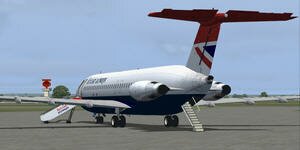
| BEA took a fleet of 18 'Supers'. They were sold off by BA in the early 90s, after excellent service. |
|
The stretched version, the 'Super One-Eleven' was originally designed to meet the requirements of BEA as the 1-11 510ED. Featuring an extended fuselage, as well as extended and redesigned wings, it was able to carry up to 119 passengers. BEA had the flight deck redesigned, fitting equipment to match their existing Trident fleet. It entered service in November 1968.
Later batches of the 500 series were fitted the definitive Rolls Royce Spey 512 turbofan and standard 1-11 flight deck equipment and they proved to be a very successful aircraft for BAC.
 |
|
| The 475 was a capable aircraft, but in the end the market wasn't there for it. |
|
|
The modified wings and upgraded engines were later incorporated into the 400 series, to make the final production version, the 475. With a very high power to weight ratio and a specially designed low pressure undercarriage, it was designed to operate from airports with shorter and lower strength runways. It could even operate from grass strips.
Targeted at Third World operators, it was too much of a niche market and did not do well in sales terms mainly because many of the airlines it was aimed at could not afford it.
By 1973 only the 500 and 475 were still in production and as the decade drew to a close, production ceased. BAC sold the rights for production to Romania, where a small number of ROMBAC 1-11's were made during the 80's.
In all 244 1-11's were made.
| |
 |
| |
| Hush-kits kept the aircraft in service through the 80's & 90's and there was no shortage of takers for a second hand model. |
|
The Rolls Royce Spey engines were notoriously loud. With the introduction of stricter environmental requirements for aircraft, in the late 70's and 80's, airlines could incur financial penalties for excessive noise around airports. Many 1-11's were modified with 'Hush-kit' engine extensions which allowed them to continue to operate.
For a while it seemed that the aircraft would be re-engined with the Rolls-Royce Tay, but in the end the commitment was simply not there to see it through. By this time, the focus had switched to the BAe 146 and it has been suggested that a re-engined 1-11 was simply too much of a threat to the new aircraft's sales.
 |
|
| EAL's fleet of 1-11's has now been retired. Noise restrictions in Europe now mean that the 1-11 is unusable as an airliner. |
|
|
Throughout the 80's and 90's the 1-11 became a popular choice for new start up airlines, particularly in the UK. However, stage III noise limitations have now forced the retirement of the 1-11 as an airliner in Europe. EAL flew the final 1-11 airliner flight in Britain in May 2002.
A number of African airlines continued to operate the 1-11 after it had retired in Europe, most notably Okada Air in Nigeria and Nationwide in South Africa. However after a recent crash in Nigeria, legislation was introduced that will probably signal the end of the 1-11 as an airliner.
There are still a number of privately owned 1-11s and a few in military service. Hopefully they will continue to operate for many years to come.
(Article by David Maltby)
BAC One-Eleven Series 500 data
Accommodation: 2 Crew & up to 119 passengers
Engines: 2 Rolls-Royce Spey 512DW turbofans 12,550lb st
Span: 93ft 6in
Length: 107ft 4in
Gross weight: 104,500lb
Max payload: 26,418lb
Max cruise: 541mph at 21,000ft
Range: 1,480 miles with max payload (with reserves)
data Civil Airliner Recognition 1973
|
|
|
|
|
|
|

