|
|
de Havilland started work on the pioneering Comet design following the Brabazon Committee's proposals for commercial aviation in 1943. A design for an aircraft to fly the Atlantic at 500 mph was proposed and was accepted by BOAC. Production started on an initial order of 8 in 1947.
The new aircraft was a huge advancement in aerodynamics, materials and performance. It had a highly pressurized cabin and with it's 4 de Havilland Ghost turbo jets, it could fly much higher and faster than previous airliners.
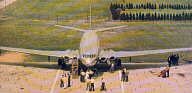 |
Pushing the boundaries carries a risk. Unfortunately the flight tests had little chance of finding the metal fatigue that would cause the fuselage to fail after prolonged use. |
The prototype first flew on 27th July 1949 and BOAC took delivery in 1951 putting the new aircraft into evaluation on a number of routes.
Weight was a concern for the early Comet. The DH Ghost engines were not really powerful enough to carry the weights required by the airlines. The Ghost was accepted by BOAC as an interim measure while the more suitable Rolls Royce Avon was developed.
Weight was saved by the extensive use of metal bonding, rather than traditional rivets and also by using very thin gauge aluminium on the fuselage. This contributed greatly to the metal fatigue which would later cause the break up of the aircraft. It has been revealed recently that some did suspect that the Comet was under strength and was rushed though its testing program. However, no one really knew the facts for certain and the doubts were clearly not great enough to halt the launch of the aircraft.
After very successful trials, the BOAC Comets started the worlds first jet passenger service in May 1952, London Heathrow to Johannesburg.
There were 3 crashes in the first year. Two were put down to pilot error, with over rotation on takeoff blamed. Another was put down to an in flight break up due to the turbulence of a tropical storm. However when another two broke up in flight in 1954, the aircraft's air worthiness certificate was revoked and the Comet was grounded.
This event sparked the largest accident investigation effort that the world had ever seen, establishing the British as world leaders in accident investigation. The Comet parts were rebuilt in a hangar as engineers searched for a cause. Another Comet was submerged in a huge water tank and was repeatedly pressurized to quickly simulate hundreds of flights. After one of these caused a rupture in the fuselage, they had the answer - metal fatigue. The repeated change in pressure had weakened the metal where the loadings were concentrated at the corner of a window panel.
| |
 |
| |
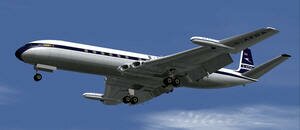
| Despite the early setbacks, the re-launched Comet 4 still managed to become the first passenger jet to operate across the Atlantic Ocean. |
|
To their enormous credit, de Havilland immediately came clean and published all of their data and findings to prevent more possible problems. This however effectively handed the market to Boeing and Douglas, with their up coming 707 and DC-8 projects also able to take full advantage of the de Havilland research.
The fuselage was strengthened and the windows were redesigned. The original square shape was changed to an oval, to dissipate the load. But the earlier Comets were discarded by the airlines.
A number of further improvements eventually saw the Comet reintroduced as the Comet 4 in 1958. It had a much longer fuselage than the earlier Comets and also included external fuel tanks on the wings, giving extended range. It was powered by 4 Rolls Royce Avon engines. BOAC kept faith with the Comet and placed a significant order.
 |
|
| The longer 4B was made specifically for BEA's routes. It had a higher capacity, but a shorter range than the Comet 4. |
|
|
BOAC started the world's first jet passenger service across the Atlantic, New York to London, with the Comet 4 on 4th October 1958. It only beat the Boeing 707 to this record by a few weeks.
The 4B was designed specifically for BEA, to service its shorter range routes. It featured a slightly extended fuselage to seat up to 99 passengers and slightly shorter wings with no fuel tank pods. It entered service with BEA at the end of 1959. The only other airline to order the 4B was Olympic, who took two. Only 18 Comet 4Bs were built.
| |
 |
| |
| The definitive 4C was mainly sold to overseas customers such as Mexicana, MEA, Sudan and United Arab. |
|
The 4C was a combination of the 4's wings and the 4B's fuselage, giving both higher capacity and longer range. This aircraft was mainly sold to overseas customers, but was also taken by the RAF. The final production total for all of the Comet 4 variants was 76. The total across the whole Comet range was 113.
Other variants of the Comet were proposed, including a Comet 5 but none got past the initial design stage. The Comet design did live on into the next era though when the Comet 4 was used by the RAF as the airframe base of the Nimrod maritime reconnosance aircraft.
 |
|
| The last stop for any Comet that still had any flying in it. Dan-Air bought most of the Comets and was the only operator of the type by 1975. |
|
|
By 1975 the only commercial operator of the Comet was Dan-Air, who became synonymous with the aircraft. Dan-Air bought 44 of the remaining aircraft, but most of these were used as spare parts to service the fleet, which never exceeded 18 at one time. The fleet declined each year, with only 6 4C's managing to reach the 1980's. The final Dan-Air Comet was retired early in 1982.
The Comet was never taken on in great numbers, due in part to it's early reputation, but mainly because those early setbacks allowed the competition time to to catch up.
The Comet 4 did go on to prove itself as a sound and reliable aircraft. It gave many years service and rebuilt the Comet name, so that it could rightly be remembered with pride as the World's first jet airliner.
| |
 |
| |
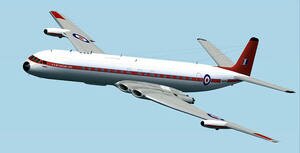
| And then there was one. 'Canopus' was the last flying example and is still kept in working order, but only on the ground. But hopefully one day... |
|
There are no Comets flying today, although there are many static examples at Museums around the world. There is only one example of a fully intact Comet 1 though, at Cosford.
The last flying example, 'Canopus' of the Royal Aircraft Establishment, has been kept in working order by enthusiasts, with regular ground runs. It was hoped that this aircraft would be returned to flying condition, but this now seems unlikely.
It can still be seen doing fast taxi runs at the regular open days at Bruntingthorpe near Leicester.
(Article by David Maltby)
DH106 Comet 4B data
Accommodation: 3-4 Crew & 71-101 passengers
Engines: 4 Rolls-Royce Avon 525 turbojets 10,500lb st
Span: 107ft 10in
Length: 118ft
Gross weight: 158,000lb
Max payload: 23,900lb
Max cruise: 526mph at 23,500ft
Range: 3,120 miles with max payload at 462mph
data Civil Airliner Recognition 1973
|
| de Havilland DH106 Comet Links |
| Martin Painter |
| Marc Schaeffer |
|
DH106 Comet 4 MS Flight Simulator Model
Models by David Maltby. Comet 4, 4B, 4C. plus Panel & Sounds |
MS Flight Simulator Model
Models for FS2002 only |
|
|
|

