|
|
| |
 |
| |
The Trident was BEA's aircraft.
But designing for one airline's needs probably lost Hawker Siddeley a worldwide winner. |
|
de Havilland's original proposal, the DH121, was a larger and more powerful aircraft than the Trident ended up being. BEA signed a Letter of Intent in 1957, which gave the go ahead for the development program to begin.
A full family of aircraft with higher capacity and new upgraded engines was intended. The Government decided, before production started, to get the Americans involved in the extended project. A US delegation including people from Boeing was given full access to the plans, but nothing came of it.
Soon after, the Boeing 727 emerged and eventually took the market, with a very similar design to the originally planed DH121.
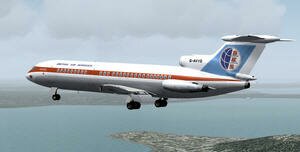 |
|
| Never truly accepted, the Trident was overlooked by the majors, in favour of the 727. Sales were usually small orders from small airlines. |
|
|
Before production of the DH121 started, BEA decided that the design had to be modified. Passenger numbers had been dropping and although this turned out to be just a dip in an upward trend, BEA insisted that the aircraft be scaled down with a capacity of only 79. This also meant that the proposed engines were now not needed and Rolls Royce Speys were used instead. With the design modified, BEA finally made a formal agreement for 24 aircraft in 1959.
In 1960, de Havilland became part of Hawker Siddeley, in the Government forced mergers which also saw the creation of BAC. The HS121, as it became known, was also given the name Trident by the Chairman of BEA. The Trident first flew in January 1962 and appeared at the Farnborough Air Show soon after in BEA colours.
| |
 |
| |
| With BEA, the Trident enjoyed a high profile status. It was used in most of BEA's advertising and was promoted as the airline's high tech flagship. |
|
BEA took delivery at the end of 1963 and after crew training and route proving, it entered service in March 1964. The early Tridents were found to be a bit underpowered, particularly lacking in takeoff performance. BEA crews had joked that it only took off because of the curvature of the earth. The improved Trident 1E had more engine power and also had high lift slats fitted and a bigger capacity. Improvements proposed by BEA eventually led to the more successful Trident 2, with the more powerful Spey 512 and a much better range. The first Trident 2 entered service in 1968.
When BEA decided it needed to replace its Vanguard and Comet fleets, several options were explored. The Trident 3, with a 16ft 5in stretched fuselage and seating upto 180, was the chosen route. Because of the lack of development in new engines, the limited engine power offered by the Spey was not enough and a small booster had to be fitted in the base of the tail. This gave either the option of a shorter take off run or an increase in capacity. The extra engine, coupled with an overall reduction in fuel capacity, meant that the Trident 3 had a much shorter range than the Trident 2. The Trident 3 entered service in 1970.
 |
|
| Although the Trident lost out to the 727 throughout the world, one major coup for Hawker Siddeley was the 35 aircraft sold to CAAC of China. |
|
|
One thing that the Trident did have in its favour was the ability to land 'blind'. The automatic landing system, developed with Smiths Industries, was finally given full CAA approval in 1972. However by this time the Boeing 727 was established as the market leader and the choice of most foreign airlines. Even so, 117 Tridents were built in total, with the last coming off the production line in March 1978. One notable sale was the 35 aircraft sold to the Chinese national airline CAAC. The Trident was CAAC's first western built short haul jet airliner.
| |
 |
| |
| In its later years with BA the Trident was a success as the airlines domestic workhorse, flying the 'shuttle' routes, linking the UK airports. |
|
BEA and British Airways always kept faith with the Trident and it became one of BA's longest serving aircraft. It was a very common sight throughout the whole of the UK during the 1980s, as it flew the BA 'Shuttle' service, connecting the major airports. It was finally retired early in 1986, after clocking up 22 years service.
It is not know for certain, but it is believed that the Trident remained in service with the Chinese Air Force until the mid 90's.
Many of the retired Tridents were used as fire training aircraft at airports around Britain and some can still be seen in various states of disrepair. Unfortunately no working examples remain.
Examples of all three Trident types are now preserved in England.
(Article by David Maltby)
|
|
HS Trident 2E data
Accommodation: 3 or 4 Crew & 97-149 passengers
Engines: 3 Rolls-Royce Spey 512-5W turbofans 11,930lb st
Span: 98ft
Length: 114ft 9in
Gross weight: 143,500lb
Max payload: 26,800lb
Max cruise: 605mph at 27,000ft
Range: 2,430 miles with max payload (with reserves)
|
HS Trident 3B data
Accommodation: 3 or 4 Crew & 128-179 passengers
Engines: 3 Rolls-Royce Spey 512-5W turbofans 11,930lb st
plus 1 Rolls-Royce RB162-86 turbojet 5,250lb st
Span: 98ft
Length: 131ft 2in
Gross weight: 150,000lb
Max payload: 32,396lb
Max cruise: 601mph at 28,300ft
Range: 1,094 miles max payload at 533mph (+ reserves)
|
data Civil Airliner Recognition 1973
|
|
|
|
|

